Tuesday, 15 April 2008

Trespassing Totnes


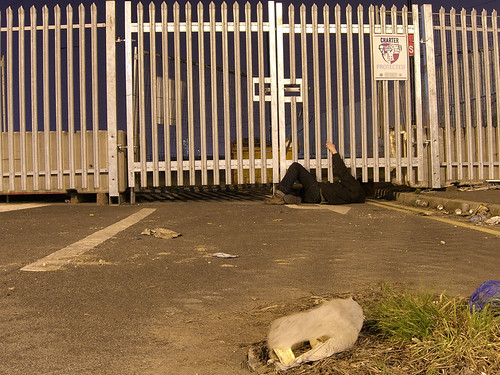
At the end of the summer, 2006, I moved to Devon to study and it's here that the project takes root in my mind and is formed into the current practice. Thinking back over the activities described below, the unwitting performativity that ties them all together, all of a sudden this is enough. The need to invite an audience to some neglected spot, to perform a series of planned actions, to be equipped with props, all vanish. I am left with the act of trespass alone and it is this which is interesting. Once this breakthrough is made, decisions come quickly - they seem obvious.

1) No domestic property (just too garden-hopping), in fact...
2) No private property.
3) No government or military installations (the work may be akin to activism but I am no saboteur)

That doesn't leave much.

I decide to focus entirely on transitional space, the three Ds: dereliction, demolition and development. Living in Totnes my options for a test run are limited (although if it were today then the abandoned Dairy Crest factory would be the perfect location). I settle on the industrial estate, specifically an aluminium fabrication plant, it is the most urban location in a small rural town. Of course I will immediately be breaking the second rule as I am sure it is privately owned but immediate self-contradiction suits my thoughts on artistic integrity these days: no dogmas, few principles.

I set off, armed with digital camera and portable tripod. It's Sunday, the industrial estate is deserted so I squeeze between the fence (being a skinny runt will continually prove a great asset to this project) and clamber around the site, a big kid refusing to leave the climbing frame. It all goes swimmingly until I make it onto the roof of the warehouse and am immediately spotted by a couple of elderly Sunday strollers from the adjacent car park. They stand and stare. I stop my clamberings and try to photograph my unexpected audience but the adrenalin kicks in too quickly and I forget to change the self-timer settings. The picture comes out a grey-green blur and I am gone pronto before they manage to tell anyone.

I am pleased with the images I get from this test-run, and buoyed up by the overall success of the trip. Getting spotted won't be such a problem in London - people just aren't nosy and if they do see me most wouldn't risk a confrontation, and anyway I won't be trespassing in daylight. Plus I am thrilled by this new perfomer/viewer relationship: the accidental audience, an incidental performance. A performance practice which is desperate to avoid attention.


Sunday, 6 April 2008

A Rude Awakening

One afternoon, spelunking for sounds around Stratford, outside the current park perimeter on the other side of the A11, I come across a large warehouse. Not a single window remains intact on any floor, and the boards that barred entrance on ground level are hanging loose. I slip inside. The ground floor is dominated by a industrial duct, wrenched from its fixings on the ceiling, it dives across the space; empty gas bottles litter a small buddleja-crowded courtyard. On the upper floors, the light pours in, the edge of the space littered with large shards of glass - the sport of local listless kids, I imagine. The building has been reclaimed at some point, the second floor has piles of human faeces at regular intervals along two of its sides.

I spend some time collecting broken glass and laying it out in a square in the middle of the space, looking a little like an abandoned arte povera piece. Mic in hand, I pace slowly around it, gently shifting my weight and recording the resulting cracks, scrapes and pops. Suddenly I become aware that I am not alone, I glance up nervously and meet the blank, silent stare of the building's sole inhabitant. Worst case scenarios reel through my head. We look at each other for what seems like a minute, but neither of us say a word, then swiftly and calmly he turns back through the door from which he must have come.

I cannot continue recording, despite his lack of concern with my presence. Every sound I make is now amplified ten times in the knowledge I am not alone, his silence is emphatic and my invasion of his derelict privacy all too awkward. I head back for the stairwell and peep through his doorway. He has made the toilet his bedroom: the only domestically scaled space available. The top floor is surprisingly homely: empty food wrappers, beer cans, palette-furnishings and an improvised washing line slung with damp tops. I am shocked by my own continued voyeurism. I scarper, quietly.

Thursday, 3 April 2008

Hi-Vis

As ever the first sign of changes on the ground is the surveyors. Roaming around Carpenters Road and Marshgate Lane (I guess this must have been late in 2006) I come across them all time, trios and quartets of men, clad needlessly in hi-vis jackets gazing through their mysterious camera-less tripods. These are the new daily inhabitants of the Lower Lea Valley, they seem to be trying to ignore the import of their job and the interest they attract from the local workers: the mechanics eye them with territorial suspicion. They are the pioneers. The first wave of hi-vis site clothing.

With them arrive the first hoardings. I think they were navy blue (or maybe purple), the all-over cyan branding of the five-mile nine-ply ring has yet to be chosen. Public relations optimism is channeled through community projects. Local primary schools have been enlisted to draw athletes and sportsmen (you can't argue with the vision of a five year old) and the products are displayed proudly, gathering industrial grime on this first partition. And not long afterwards, the first road closure, my instinct is to climb it, but it is daylight. Using the handily placed road-block bollards I get a better view and look down on a large marquee, I flash back to breaking into a festival the summer before, landing directly beside the security tent creeping out of its shadow, straight into a cluster of guards on their fag break, not to be repeated. I give this spot a miss when I return after dark.

Sunday, 30 March 2008

Learning to Play Fences

My first solo trespasses are purposeful rather than symbolic. I had decided to make a sound-portrait of the area, a typically over-ambitious project to document the changing soundscape over the five year period in which the site will be transformed. This idea is soon curtailed and transformed and eventually completed in about nine months, resulting in Lament for the London Olympic Site a field-recording composition broadcast through the Radia network, on Resonance FM and a dozen-odd other (mainly european) independent radio stations in the summer of 2007. Luckily the project is completed before the blue barricade prevents the easy transportation of audio equipment into the site.

For a while though, on every visit I went equipped with microphones, headphones and mini-disc recorder. At this time the pre-olympic zone was a field-recordist's dream (perhaps with the exception of the large amount of freight traffic). Abundant wildlife existed amongst hulks of resonant metal, trains rumbled above marshland, the wind activated everything. Removed from the extraneous background noise of the inner-city, here was contained all the sonic potential of both urban and rural environments. One night, using a discarded tyre as leg up onto the fence, I clamber from the Arena Recreation Ground (at the north western corner of the current cordon) into the yard behind what I assume is a recycling plant. Pressing my ear against the galvanized side of gigantic water tank, on which a bemusing NO SNORKELING sign is pasted, I can just about discern a steady drip. Using a palette to close the gap to the bottom of the ladder and climb to the top. I lie there for half an hour, microphone suspended inside capturing the reverberating drips, staring at the stars, cold. And this is my first tentative intervention, exploring here is no longer a hobby. I am captivated by the place.

On a later (post-fence) visit to the same place the tank has been adorned with the largest and best work of the proficient 'teeth' graffiti artist, enormous exposed gums and pearly-white molars wrapped around it's steel. This is the point where my suspicions that I am far from alone in disregarding the cordon are confirmed, which makes me happy, on the way out that night I notice that the top of the fence where I am climbing shows the signs of its abuse, a dirty patch where it has been scaled, not just by me. Here's where it stood:

The sound hunting gathered pace from that day on. I kneel outside Pudding Mill Lane station, two contact mics attached to a towering lamppost, filtering the all of the nearby activity into a metallic drone. One Christmas day I crouch on a towpath recording the groans of corrugated sheet hanging from a lone strand, sounding like a detuned cello. And I start to bow fences. This discovery soon takes on a life of its own. I become fascinated by the acoustic properties of the city's protective barriers and conceptually enamored with the re-appropriation of these hostile, divisive objects as musical instruments. They contain a seemingly endless range of frequencies and timbres beneath the thin coating of zinc. In a short time, numerous recordings are made under the pseudo-scientific banner of Attempts to shatter steel with sound. But up to this point I remain blissfully unaware of the role fences will continue to play in my life for the next three years.

Thursday, 27 March 2008

This is not a Brownfield Site

One of our windswept sunday jollies took us along Waterden Road. Something had changed, I was perplexed - unable to visualise what had occupied the space previously. Opposite the old self-storage warehouse, in the shadow of which a shack-like greasy spoon had long stood, there was a new gap towards the horizon. A freshly tarmaced road led straight as a die into the distance, seemingly serving nowhere and nothing, the distance looked barren and building-less. We ventured onto the road, fully aware that this looked forbidden territory. Sure enough, drawing alongside a porta-security-hut one of a number of black men who had been huddled inside listening to one of the local African pirate radio stations appeared and turned us back, friendly. I never really got the place out of head (and still haven't).

Once this project was off the ground (my attempt at chronology ends here) it was one of the first places I headed for. The security hut was gone, probably long ago and replaced by the ubiquitous railway-siding style fence, not very well - they had left a large gap beneath it. I had scouted the unknown territory via Google Earth, and was amazed to find it even more barren than was imaginable at ground level. An enormous expanse of mud opened up in all directions just a couple of hundred metres down this road to nowhere. This area must make up at least one third of the current Olympic Park development site.

I squeezed beneath the fence with ease, having to do it twice for the sake of posterity. Off to the left there was a brightly lit area and the sound of a generator droning away. I have by now become used to the fact that lights and gennys are left to burn all night long for no reason, but, at the time, I assumed this indicated human activity, so crept slow and low along the bridge section of the road, until I could hop over the crash barriers onto a grassy bank which would keep me well hidden for the rest of the open stretch. The mud was cracked, looking a parched lake. There was one building and outside it to my shock, a land rover parked. Trespassing does not help my natural tendency towards paranoia, and wondering why anyone would leave their car here, behind a locked fence, in as much the middle of nowhere as it is possible to be in London, I again predicted disaster - this must be security. Hurriedly I looked for a dip in the plain and ended up charging down a bank and ending up next to the railway line. I stayed here, calmed down and took some more photos.

The area was so empty that I struggled to improvise composition without the usual industrial props, I had a torch though, so tried walking across the frame in the long exposures, then just sat on a nearby cable-reel, and watched the trains pass. Back up at road level, calm but cautious I skirted around at a safe distance from my phantom security van, looking for the bridge which i knew led to the northern half of this wasteland. Crouched beside it and peering into the underpass beneath, I could make out a Eurostar ticking over, strange as I thought the extension to Stratford was not complete, but this is where they will end up. If only the arriving tourists knew what was above them as step off the glossy white and yellow carriages: not the bustle of a capital city, but one of the only areas of the city on which nothing has ever been built, one of London's few greenfield sites, ironic that it's so brown. Except that by the time any tourists do alight at Stratford the virtual Olympic village will have become reality. I venture no further that evening, which I regret now and on my way out I discover the lights and generators indicate nothing yet refrain from standing among them for another shot, which I also regret.

Tuesday, 25 March 2008

Fuck Seb Coe

Sometime in 2005 our household began the semi-regular activity of industrial tourism: sunday jaunts around the post-industrial urban wastelands of east London. We visit Beckton Alp, Woolwich and the Thames Barrier and, of course, the Wick. By this time the shocking news that London had trumped Paris has broken and interest in documenting the Lea Valley as it stands is beginning to peak. It's days are numbered, community groups are mobilising, but the awareness that the unstoppable juggernaut of urban progress is finally going to wipe away this forgotten backwater could not be keener.

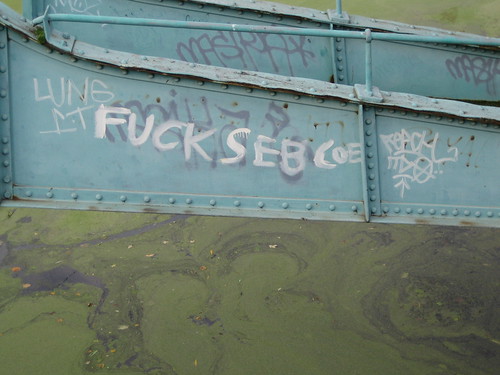
Over the next few months I return, both alone and accompanied, to absorb the details. We pass other pre-Olympic tourists on the towpaths, clutching the variety of imagined maps and landscape schemes that the Bid has produced, trying to marry up the overgrown present with the .pdf future. Anger is in evidence everywhere. FUCK SEB COE is scrawled on the footbridge over City Mill River and local businesses have teamed up to produce banners protesting their compulsory relocation.

It's in the sloganeering that the transference of ownership is first revealed. As site visits by the Olympic Commitee are announced the dissenting voices are quickly painted out and slick Olympic graphics replace the angry block caps banners. The same strategy of erasure is now being used, not only wholesale across the landscape itself, but on the blue fence against all the grafitti for which it openly begs.

Photos by Martin Lewis, thanks.

Monday, 24 March 2008

The Removal of Fridge Mountain

Four years after acquainting myself with the hinterland of Hackney Wick by attending it's illegal raves it became part of my daily routine. I got an agency job working in Stratford, doing six hour shifts renovating tube trains, and cycled from Homerton every morning at dawn. My route took me down Carpenter's Road, past the taxi hospitals and breaker's yards.

On the other side of the road was the area's biggest landmark: fridge mountain. Towering about 20ft into the air, a monument of domestic appliance waste, the biggest heap of fridges in Europe. The mountain was the first thing to go, as the Independent on Sunday reported:

"The Hackney fridge mountain is already gone. Can the cooking-fat recycling plants and the kebab-meat factories on Pudding Mill Lane ... be far behind?"

It's strange that what most of the population would consider an eyesore caused quite so much nostalgic reflection. A fridge is a fairly ugly object, but thousands of the things, their doors gaffer-taped closed, seemed to resonate with the area (though I'm fairly sure to the taxi-mechanics on the other side of the road, there was no such sentimentalism).

The Google Earth images of the area have since been updated and although they cannot possibly keep apace with the development currently underway, these two do provide a nice microcosm of what has been happening in the last nine months across the whole 1000 acre site.

An Early Incursion


Climbing the fence into what used to be Manor Garden Allotments, long before the erection of the blue fence. There is a slideshow of pictures from this project here, which is updated fairly regualrly.

Keverything Begins with K

I thought I may as well try to do this chronologically, though I'm not sure how long I will be able to keep that up. But anyway - here goes.

My first memory of what has now become the site for London 2012 took place about ten years ago in 1998, just after I left school, moved back to London to go to art school and soon discovered the pounding underbelly of the capital: the squat party scene. Hackney Wick was once the centre of this grimy underground culture, with one of its warehouses being appropriated as a rave space almost every weekend, and a building on Waterden Road (now of course demolished) was one of the longer-standing venues. I (hazily) remember two parties there, among the more homely atmospheres, with little of the nagging threat that has become so common at the events, or perhaps I was just naive.

Finding the buildings has always been half the fun, and on this particular evening I remember pricking up my ears as we traipsed along the Eastway, keen to discern that tell-tale thudding that emanates from all parties, no matter what the DJ is playing. The area was deserted and having not ventured so far into London's industrial hinterlands before I was struck by the amount of sky, the openness of the space. A few minutes later we squeezed between the chained fence, handed over our £3 each and joined the thrall. At the end of the night I took as a memento a sticker from the door jam which read "Keverything begins with K", not a motto to live-by, but it did capture something of the zeitgeist.

I am not an expert on the law regarding squatter's rights, but I guess this was also the first time I had trespassed in London. The impact of this activity on my current practice of scaling the Olympic fence cannot really be overemphasised. From that evening onwards I became ever more convinced by these parties; not just as places to drink, dance and take drugs without the unwanted attention of bouncers and excessive door charges; but also in their transformative use of forgotten spaces as autonomous social hubs, often for a single night. Squat parties are not without their problems. I have also attended one rave, not far away, at which someone died of an overdose, and sadly muggings are not rare: this is the world we live in . But when the organisers succeed in keeping out the crack and the greedy, they are setting an example of anarchy that works, a self-regulating party where people can enjoy unlicensed entertainment. It tastes different.